Should You Repair or Replace Your Commercial Rooftop Unit?
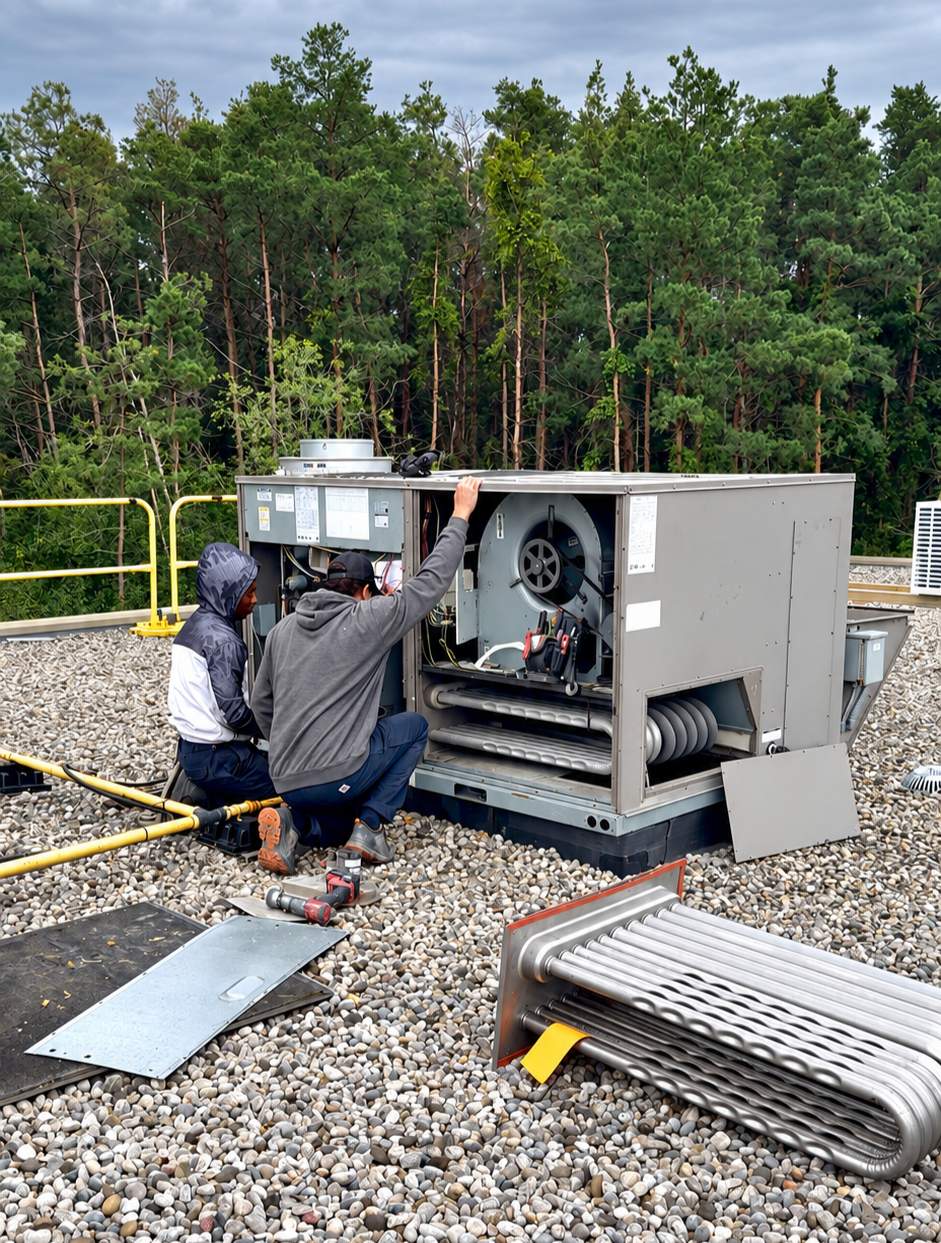
Rooftop Technician During an Assessment
Your rooftop unit is down again. The repair quote is on your desk, people are complaining about the temperature, and you need to decide whether another repair is a sensible investment.
Repairing a commercial rooftop unit can make sense when the fault is isolated, the rest of the equipment is in serviceable condition and the system still meets the building’s needs. Replacement deserves consideration when major deterioration, repeated failures or changing requirements make continued repairs difficult to justify.
The decision needs more than the age of the unit or the price of one component. You need to understand what failed, why it failed, what remains in good condition and what each option will mean for your facility.
This guide is for facility managers, property managers and building owners comparing commercial rooftop HVAC repair and replacement in Durham Region and the Greater Toronto Area.
When does repairing a commercial rooftop unit make sense?
A breakdown does not automatically mean the whole unit needs replacing. A specific component fault or control problem may be repairable without replacing otherwise serviceable equipment.
Before approving the repair, ask your contractor:
What caused the problem? Distinguish the failed component from the condition that caused it to fail.
What else was checked? Understand whether the recommendation follows a system assessment or only a diagnosis of the immediate fault.
Will the repair address the complaint? Restoring operation and resolving persistent comfort problems are not always the same thing.
What is included? Confirm labour, parts, testing, exclusions and applicable warranty terms.
A clear repair recommendation should explain what the work is expected to resolve and identify any remaining concerns. It should not imply that replacing one part makes every other component new.

Row of newly replaced RTU units
When should you consider rooftop unit replacement?
Consider a replacement assessment when the equipment has several significant problems, repairs are becoming disruptive, or the system no longer suits the space it serves.
Useful reasons to investigate replacement include:
Repeated failures that interrupt occupied areas or operations.
Significant deterioration affecting major components or the cabinet.
Replacement parts that are difficult to obtain within an acceptable timeframe.
A substantial repair alongside other documented deficiencies.
Building alterations, occupancy changes or operating requirements the existing system cannot adequately support.
Age is context, not a diagnosis. An older unit with a clear, repairable fault should not receive the same recommendation as one with extensive deterioration and a history of recurring problems.
Ask for the evidence behind the recommendation. Photographs, service history and recorded findings are more useful than a statement that the unit is simply “getting old.”
Why does your rooftop unit keep breaking down?
Repeated breakdowns call for a broader investigation before another component is replaced. Depending on the equipment and symptoms, a qualified technician may need to examine airflow, coils, fans, electrical components, refrigerant-system operation, heating operation and controls.
The building also matters. Changes to operating hours, space use, ventilation needs or control schedules can affect how the system performs. Carrier’s rooftop troubleshooting training treats refrigeration, heating, economizers, air-side operation and controls as related diagnostic areas, which reinforces the value of looking beyond one symptom.[1]
Give your contractor the pattern:
Which area is affected, and at what times?
Does the issue appear during particular weather or operating conditions?
What alarms or complaints recur?
What work was completed before the problem returned?
Keep previous service reports together. That record can help distinguish a recurring fault from separate failures and make the next assessment more useful.
How can rooftop replacement work be planned around building operations?
Discuss the occupied space and the consequences of a shutdown before setting an installation date. Identify areas that need heating, cooling or ventilation, along with access restrictions, delivery activity and any operational requirements that affect scheduling.
Ask your contractor to explain the sequence: equipment delivery, removal, installation, reconnection, startup and handover. Clarify who coordinates any other trades and what happens if weather, access or equipment delivery changes the plan.
Replacing the unit does not automatically resolve every airflow or comfort issue inside the building. Existing distribution and controls concerns should be considered in the agreed scope.
For ongoing care after the work, see our guide to how often a warehouse HVAC system should be serviced.
A Tracey Refrigeration rooftop replacement project
At Pioneer Gas Station, the reported problems included dripping glass doors, melting chocolate bars and uncomfortable indoor conditions. Tracey Refrigeration installed a new Trane rooftop unit to address the cooling problems.
Our published project summary describes improved conditions following the installation.[3] It is a practical example of how commercial HVAC problems can affect both the people in a building and the products inside it.
Every site needs its own assessment. The right next step for your property depends on the condition of your equipment and the cause of your complaints.
Need a rooftop unit assessment in Durham Region or the GTA?
If you are deciding whether to approve another repair or plan a replacement, tell us what your equipment is doing and how it is affecting the building.
Tracey Refrigeration is based in Oshawa and serves commercial and industrial facilities across Durham Region and the GTA, including Whitby, Ajax, Pickering, Toronto and Mississauga.
When requesting an assessment, include your facility location, the main problem and whether you are dealing with a current failure, a recurring issue or planned replacement. Existing service reports and an equipment model number are helpful if available.
Request a Repair-or-Replace Assessment
Call 905-622-6079 or email info@traceyrefrigeration.com to discuss your facility and the appropriate next step.
